
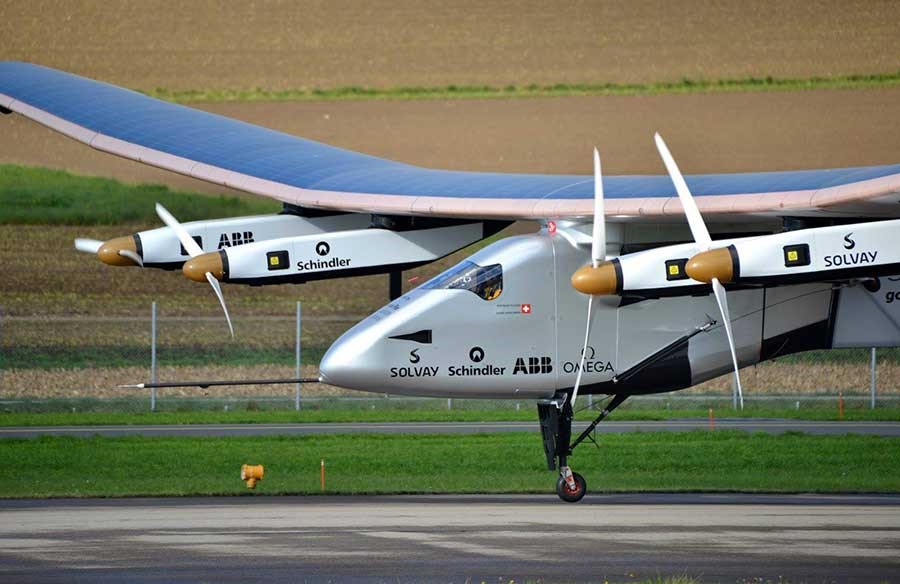
The Solar Impulse 2, built in Switzerland, has made history as the world’s largest solar-powered aircraft by completing a groundbreaking journey around the world — covering 40,000 kilometres using only sunlight.
This achievement marks a major milestone in the world of renewable energy and aviation, demonstrating the enormous potential of clean technology.
The mission began in Abu Dhabi in March 2015 and concluded there in July 2016, after stops in countries like India, China, Japan, the United States, Spain, and Egypt. Pilots Bertrand Piccard and André Borschberg took turns at the controls during this demanding journey.
The aircraft’s success has inspired innovators worldwide to explore sustainable solutions in transportation and energy.
For more details on the technology behind Solar Impulse 2, check our page on solar technology innovations.
Solar Impulse 2 is equipped with over 17,000 solar cells that power four electric motors and charge onboard batteries, allowing it to fly day and night without fuel.
The aircraft’s lightweight design and cutting-edge engineering made this journey possible, though weather conditions and technical challenges tested the limits of the team.
You can read more about the mission on the official Solar Impulse Foundation website.
The mission was not just about aviation; it was a statement on the urgency of adopting clean energy. As Bertrand Piccard said, “We wanted to show that clean technologies can achieve the impossible.”
For related articles, visit our sections on renewable energy and sustainability in aviation.
The success of Solar Impulse 2 has sparked new projects focusing on zero-emission transportation. Companies and researchers worldwide are now exploring electric planes, hydrogen-powered aircraft, and advanced battery systems.
To stay updated on these innovations, follow the International Renewable Energy Agency and NASA’s sustainable aviation projects.
Your privacy is important to us. It is the policy of LA Dream Travel & Services Lda to respect your privacy regarding any information we may collect on the LA Dream Travel & Services Lda website and other sites we own and operate.
We request personal information only when we truly need it to provide you with a service. We collect it by fair and lawful means, with your knowledge and consent. We also inform you why we’re collecting it and how it will be used.
We only retain collected information for as long as necessary to provide you with your requested service. When storing data, we protect it using commercially acceptable means to prevent loss and theft, as well as unauthorized access, disclosure, copying, use, or modification.
We do not share personally identifiable information publicly or with third parties, except when required by law.
Our website may contain links to external sites not operated by us. Please be aware that we have no control over the content and practices of those sites and cannot accept responsibility for their respective privacy policies.
You are free to decline our request for personal information, with the understanding that we may be unable to provide some of your desired services.
Your continued use of our website will be regarded as acceptance of our practices around privacy and personal information. If you have any questions about how we handle user data and personal information, feel free to contact us.
The Google AdSense service we use to serve advertising uses the DoubleClick cookie to serve more relevant ads across the Web and to limit the number of times a given ad is shown to you.
For more information about Google AdSense, please refer to the official Google AdSense Privacy FAQ.
We use ads to offset the costs of operating this website and to fund future development. The behavioral advertising cookies used by this site are designed to ensure that you receive the most relevant ads whenever possible by anonymously tracking your interests and presenting similar things that may be of interest.
Several partners advertise on our behalf, and affiliate tracking cookies simply allow us to see if our customers have come to the site through one of our partners’ sites so that we can properly credit them and, where applicable, allow our affiliate partners to offer any promotion that may provide you with a discount when making a purchase.
The user agrees to make appropriate use of the content and information that LA Dream Travel & Services Lda offers on the site and, by way of example but not limitation:
A) Not engage in activities that are illegal or contrary to good faith and public order;
B) Not disseminate propaganda or content of a racist, xenophobic, gambling, illegal pornographic, terrorist-supporting, or human rights-violating nature;
C) Not cause damage to the physical (hardware) and logical (software) systems of LA Dream Travel & Services Lda, its suppliers, or third parties, or introduce or spread computer viruses or any other hardware or software systems capable of causing the aforementioned damages.
We hope this has been clarified. As mentioned before, if there’s something you’re not sure whether you need or not, it’s generally safer to leave cookies enabled in case it interacts with one of the features you use on our site.